RESEARCH USE ONLY - Not for human or veterinary use. Supplied for lawful in vitro research and qualified laboratory investigation only. QUALITY - Peptide catalogue items are specified at ≥99% purity with batch documentation. Store lyophilised powders as directed before reconstitution. COMPLIANCE - You are responsible for lawful purchase, possession, and use in your jurisdiction, including institutional and safety requirements. SAFE HANDLING - Use trained personnel, appropriate PPE, and aseptic technique. Do not ingest, inject, or use outside a controlled research setting. POLICIES & ORDERS - Shipping, returns, and research-use terms apply to every order. Read our Research Use Policy and footer legal links before buying.
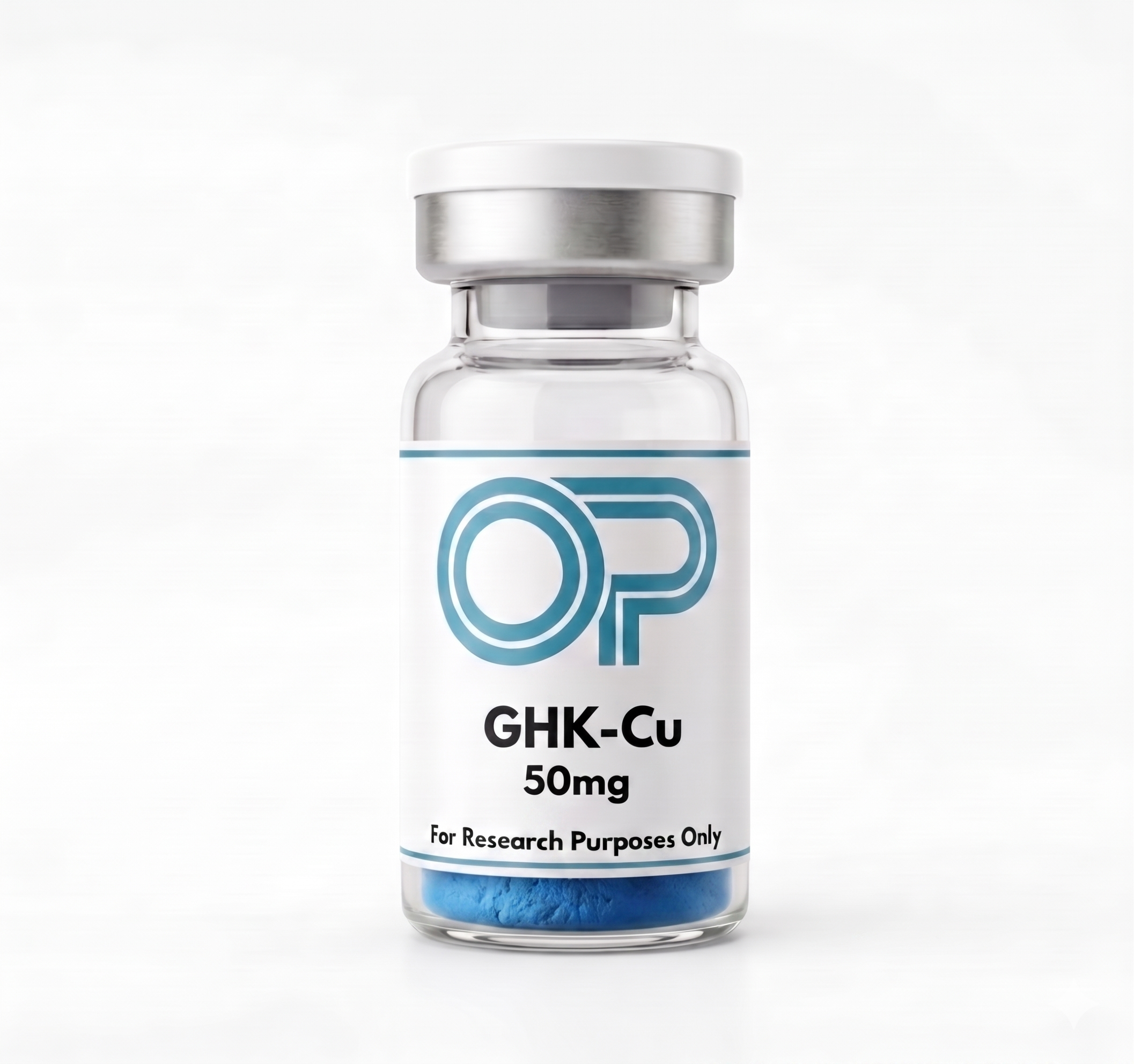
GHK-Cu 50mg lyophilised vial - for research purposes only
Purity
≥99%
Format
Lyophilised
Documentation
CoA on request
Storage
−20°C
Copper Tripeptide · Regenerative

GHK-Cu — Copper Peptide

Glycine-Histidine-Lysine Copper · Endogenous Tripeptide

≥99% Purity
CoA Available

GHK-Cu is an endogenous copper-binding tripeptide composed of glycine, histidine, and lysine, first isolated from human plasma in 1973 by Loren Pickart. It forms a stable complex with copper(II) ions, which is essential for its biological activity. GHK-Cu naturally occurs in plasma, saliva, and urine, with plasma concentrations declining significantly with age. It is one of the most extensively studied regenerative peptides, with research spanning wound healing, collagen biosynthesis, anti-fibrotic activity, and antioxidant defence mechanisms.

Size - 50mg

Supplied as 50mg lyophilised peptide per vial (single presentation).

£34.99
View Cart →

What is GHK-Cu?

GHK-Cu (glycyl-L-histidyl-L-lysine copper) is a naturally-occurring tripeptide-copper complex with widespread biological activity. First isolated from human plasma albumin by Dr Loren Pickart in 1973, GHK-Cu has since been identified as a key signalling molecule in tissue repair and regeneration. Plasma concentrations of GHK are approximately 200 ng/mL in young adults, declining to around 80 ng/mL by age 60, a reduction that correlates with impaired tissue repair capacity observed in ageing.

The peptide's biological activity is critically dependent on its copper(II) chelation. The GHK tripeptide forms a square planar complex with copper ions via the amino terminus and the imidazole of histidine, creating a stable chelate that facilitates copper transport into cells. This copper delivery is central to GHK-Cu's role in activating copper-dependent enzymes involved in collagen crosslinking (lysyl oxidase), superoxide dismutation (Cu/Zn-SOD), and melanin synthesis (tyrosinase).

Full Name
Glycyl-L-Histidyl-L-Lysine Cu(II)
Pack size
50mg per vial
Product Code
GHK-Cu
Origin
Endogenous (Human Plasma)
Mechanism
Copper Chelation / Gene Regulation
Molecular Weight
340.4 Da (free tripeptide)
Structure
Linear Tripeptide + Cu(II)

Research Background

GHK-Cu has one of the broadest research profiles of any bioactive peptide. Over five decades of investigation have identified the following key research areas:

  • Wound Healing & Tissue Repair: GHK-Cu accelerates wound closure in research models through stimulation of fibroblast migration, proliferation, and extracellular matrix remodelling. Studies demonstrate upregulation of collagen, elastin, proteoglycans, and glycosaminoglycans.
  • Collagen Synthesis: GHK-Cu potently stimulates collagen type I and III synthesis in fibroblasts while simultaneously inhibiting excess collagen production and reducing fibrosis - a uniquely balanced regulatory profile with implications for scar reduction research.
  • Antioxidant Activity: GHK-Cu upregulates the expression of Cu/Zn-superoxide dismutase and other antioxidant enzymes, providing cellular protection against oxidative stress in research models.
  • Hair Follicle Stimulation: Multiple studies demonstrate GHK-Cu's ability to enlarge hair follicles, stimulate hair growth, and reduce hair loss in research models, with proposed mechanisms involving follicular keratinocyte and dermal papilla cell activation.
  • Gene Expression Modulation: Gene array studies indicate GHK-Cu modulates over 4,000 human genes, with a consistent pattern of upregulating tissue repair genes and downregulating genes associated with inflammation, cancer progression, and degenerative disease.

Technical Specifications

Appearance
Blue/Blue-Green Powder
Purity
≥99%
Format
Lyophilised (Freeze-Dried)
Reconstitution
Sterile Water or PBS
Storage (Lyophilised)
−20°C, protected from light
Storage (Reconstituted)
2–8°C, use within 14 days
Shelf Life
24 months (lyophilised)
CoA
Available on Request

Frequently Asked Questions

Why does GHK-Cu have a blue/blue-green colour?

The characteristic blue-green colour of GHK-Cu powder and solutions is due to the copper(II) chelate complex. The copper atom coordinated within the peptide absorbs specific wavelengths of visible light, producing the distinctive colouration. This colour confirms the presence of the copper-peptide complex and is an expected physical characteristic.

What solvent should be used for reconstitution?

GHK-Cu is highly water soluble and can be reconstituted in sterile water, phosphate-buffered saline (PBS), or other aqueous research buffers. Unlike some peptides, bacteriostatic water is not required for GHK-Cu due to its low molecular weight and high solubility. Prepare solutions at the concentration required for your specific research protocol.

Is a Certificate of Analysis provided?

Yes. A CoA documenting batch purity and specifications is available for every batch on request.